Home Care vs. Nursing Home: Costs, Programs & How to Choose
Also searched as “aged care vs. nursing home.” It’s
the same question. This guide covers both.
Maybe you got a call from the hospital late at night. Maybe you watched
your father get up slowly, again, for the third time this week. If
that’s why you’re here, you are not overreacting. You are not
alone. Most families start looking for answers in a hard moment, not
before one. That doesn’t mean you waited too long to get this right.
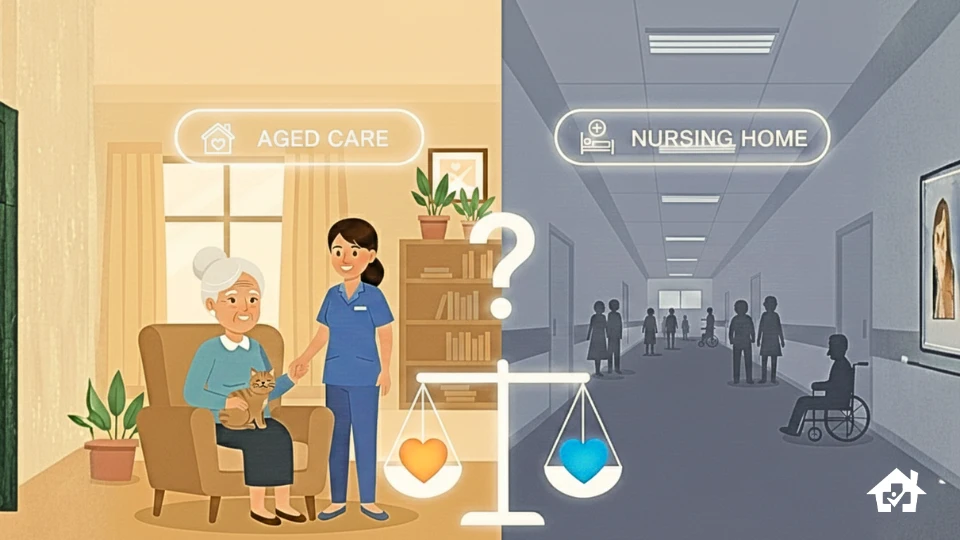
You may have searched “home care vs nursing home.” Or you may
have searched “aged care vs nursing home.” Most U.S. families
mean the same thing by both. But the second phrase can confuse people. In
Australia and the U.K., “aged care” means all care for older
adults, including nursing homes. In the U.S., it usually means the
opposite: care given at home, not in a facility. If a website treats the
two terms as the same thing, it was likely written for Australia or the
U.K. It wasn’t written for the U.S.
We are Cottage Home Care Services. For more than 30 years, we’ve
helped families in New York, New Jersey, Maryland, and Michigan choose
between home care and nursing homes. In this guide, “home
care” means care given at home. “Nursing home” means a
licensed skilled nursing facility, or SNF.
What’s the Real Difference Between Home Care and a Nursing Home?
Quick answer
Home care lets an older adult stay in their own home. A caregiver helps
them, for a few hours a week or all day and night. A nursing home is a
licensed facility with nurses on-site all day and night. It’s
built for people who need constant medical care.
Home care usually includes:
-
A personal care aide (PCA) or home health aide (HHA) who helps with
daily tasks. This means bathing, dressing, and moving around. It also
means cooking, light housekeeping, and rides to appointments.
-
Visits from a nurse (RN or LPN) to manage medicine, care for wounds, or
check fall risk.
-
Flexible hours. This can be a few visits a week, or a caregiver who
lives in the home.
-
Payment through Medicaid waivers, long-term care insurance, or private
pay.
A nursing home usually includes:
-
Nurses (RNs, LPNs) and aides (CNAs) on-site all day and night.
-
Staff who give medicine, treat wounds, and provide therapy as part of
daily care.
-
A private or shared room in a licensed building, with a case manager
checking the care plan.
-
Government oversight through required assessments (the Minimum Data
Set) and public quality ratings.
Neither choice is always better. The right one depends on how much medical
care your loved one needs. It also depends on whether their home can be
made safe enough.
Setting
Nursing Home (SNF)
Licensed facility, private/semi-private room
Staffing
Home Care
PCA/HHA daily, RN/LPN visits
Nursing Home (SNF)
RNs and CNAs on-site 24/7
Schedule
Home Care
Flexible, built around the family
Nursing Home (SNF)
Fixed facility routine
Best for
Home Care
Help with daily tasks, not constant medical care
Nursing Home (SNF)
Continuous nursing care or complex medical needs
Typical funding
Home Care
Medicaid waivers, private pay, LTC insurance
Nursing Home (SNF)
Medicaid, Medicare (short stays only), private pay
Oversight
Home Care
Care plan managed by agency RN
Nursing Home (SNF)
Government 5-star rating via Care Compare
Home Care vs. Home Health Care: The Mix-Up That Trips Up Almost Everyone
People online often mix up these two terms. That mix-up is why families
get surprised by a bill, or by a denied claim. The two terms are not the
same. They’re covered in different ways.
What it is
Home Care (custodial)
Help with bathing, dressing, meals, light housework, and company
Home Health Care (skilled)
Nurse visits, wound care, therapy, and help with medicine
Who provides it
Home Care (custodial)
Home health aide (HHA) or personal care aide (PCA)
Home Health Care (skilled)
RN, LPN, or licensed therapist
How it’s ordered
Home Care (custodial)
The family sets it up with an agency
Home Health Care (skilled)
A doctor must order it for a specific health need
Medicare coverage
Home Care (custodial)
Not covered, even long-term
Home Health Care (skilled)
Covered for a short time if you can’t leave home and a doctor
says you need it
Typical funding
Home Care (custodial)
Private pay, Medicaid waivers, long-term care insurance
Home Health Care (skilled)
Medicare, Medicaid, private insurance
Say a caregiver helps your father shower and make lunch each morning.
That’s home care. Say a nurse visits twice a week to change a wound
dressing after his hip surgery. That’s home health care. Many
agencies, including ours, offer both. But they’re billed and covered
under different rules. If a bill or a denied claim surprises you, this is
often why.
Here’s a related question: is a nursing home stay the same as a
rehab stay?
Not always. Many nursing homes run both a short-term rehab unit and a
long-term care unit under one roof. Rehab has a clear end date. It uses
physical, occupational, or speech therapy after a hospital stay, with the
goal of getting your loved one home. Long-term care has no set end date.
The focus shifts from getting better to daily care. If your loved one is
leaving the hospital, ask the facility directly: is this short-term rehab,
or long-term placement? The Medicare rules below are different for each
one.
Home Care vs. Nursing Home Cost: The Real Numbers
Quick answer
For most families, home care costs less if it’s under about 40 to
44 hours a week. Above that, a nursing home’s monthly rate is
often the better deal, because it already covers housing, meals, and
staff all day and night.
What that hourly rate actually pays for
Families are usually quoted about $33 to $35 an hour for a home health
aide. That number surprises people, because caregivers don’t take
home anywhere near that much. The U.S. Bureau of Labor Statistics says
home health and personal care aides earned about $12 to $21 an hour in
2025. The exact amount depends on the region and the caregiver’s
experience.
So where does the rest of the money go? It covers real costs, not extra
profit:
Cost component
Caregiver wages
Approx. share of billed rate
45 to 55%
Cost component
Payroll taxes (FICA 7.65%, unemployment insurance)
Approx. share of billed rate
8 to 10%
Cost component
Benefits (workers’ comp, liability insurance, PTO where
offered)
Approx. share of billed rate
10 to 15%
Cost component
Supervision, scheduling, RN care plan oversight, background
screening
Approx. share of billed rate
10 to 15%
Cost component
Agency overhead and margin
Approx. share of billed rate
10 to 20%
What different care schedules cost per month
Here’s what care can cost each month, based on a rate of $33 to $35
an hour:
Hours/week
20 (part-time)
Monthly cost
$2,850 to $3,050
Notes
Common for early-stage support
Hours/week
40 (full-time)
Monthly cost
$5,700 to $6,100
Notes
Below most nursing home rates
Monthly cost
$8,550 to $9,100
Notes
Approaching nursing home cost range
Hours/week
84 (12 hrs/day)
Monthly cost
$12,000 to $12,750
Notes
Often exceeds a semi-private nursing home room
Hours/week
168 (24/7 live-in)
Monthly cost
$18,000 to $25,000+
Notes
Usually well above nursing home cost
For comparison, the 2025 Cost of Care Survey from CareScout (Genworth)
found a national median nursing home cost of $315 to $355 a day.
That’s about $9,600 to $10,800 a month. The price depends on whether
the room is shared or private.
Costs vary a lot by state. New York is one of the most expensive states
for nursing home care. Some surveys put shared-room rates there above
$180,000 a year. That usually makes home care the better deal, if your
loved one doesn’t need round-the-clock nursing. In cheaper states,
the gap is smaller. High-hour home care can even cost more than a nursing
home room in some cases. Ask us for current numbers in your county; these
figures change every year.
What the Nursing Home Rate Includes That the Home Care Rate Doesn’t
The numbers above can make home care look like the cheaper choice. It
often is, but only if you compare the full picture. The $9,600 to $10,800
a month nursing home price is close to all-inclusive. It already covers
the room, three meals a day, utilities, laundry, housekeeping, and staff
all day and night.
Home care’s hourly rate covers only the caregiver’s time. Your
loved one still pays for everything else that comes with living at home:
-
Mortgage or rent.
-
Property taxes and homeowners or renters insurance.
-
Utilities (heat, electric, water).
-
Groceries and meal preparation supplies.
-
Home maintenance and any accessibility modifications.
-
A medical alert system or fall-detection device.
If the mortgage is paid off, these costs are usually small next to the
savings on care. Maybe your loved one rents in an expensive area. Or they
still pay a mortgage, taxes, and full utilities. If so, the real gap is
smaller than it looks. Add up all their monthly living costs. Don’t
just compare the care bill.
What you don’t need to worry about
You don’t have to pick the most expensive option to get good care. A
2019 study in JAMA Internal Medicine looked at more than 17 million
Medicare hospital stays. It found that patients sent home with home health
care cost Medicare about $4,514 less over 60 days. That’s compared
to patients sent to a nursing facility. There was no real difference in
deaths within 30 days.
Owning a home doesn’t stop a family from getting Medicaid home care.
The home is usually an exempt asset, as long as the applicant or their
spouse still lives there.
A nursing home stay isn’t always permanent. Medicare covers
short-term rehab stays after a qualifying hospital stay. Many people go
home afterward with a home care plan.
What Medicare and Medicaid Actually Cover
Quick answer
Medicare covers short-term skilled nursing care after a qualifying
hospital stay. Costs to you rise sharply after day 20. Medicaid covers
long-term nursing home care in every state. It also covers home care
through state waiver programs. Each state sets its own income and asset
rules.
Medicare’s skilled nursing facility (SNF) benefit
-
Requires a 3-day hospital stay right before entering the nursing
facility.
-
Days 1 to 20: fully covered, $0 a day.
-
Days 21 to 100: you pay a daily amount, a few hundred dollars a day,
adjusted each year.
-
Day 101 onward: Medicare pays nothing; you pay out of pocket, or switch
to Medicaid if you qualify.
-
Medicare does not cover long-term custodial care, at home or in a
nursing home.
Medicaid’s long-term care rules (2026 federal figures)
-
Individual asset limit: usually $2,000 in countable
assets for one person.
-
5-year look-back: Medicaid checks your finances from
the past 60 months. If you gave away money or property in that time
without getting paid back, you may face a penalty that delays when you
qualify.
-
Community Spouse Resource Allowance (CSRA): if one
spouse applies and the other stays home, the spouse at home can keep
$32,532 to $162,660 in assets, depending on the state and the
couple’s total resources.
-
Minimum Monthly Maintenance Needs Allowance (MMNA):
the spouse at home is guaranteed $2,643.75 to $4,066.50 a month in
income.
These are federal minimum and maximum amounts. Your state picks its own
number inside that range. Check the exact figure with your state Medicaid
office or an elder law attorney before you make financial decisions.
What “spending down” actually looks like
You’ll hear about the 5-year look-back a lot. But families are
usually more surprised by the spend-down itself. Here’s what it
means. Say your loved one has $50,000 in savings, and the asset limit for
one person is $2,000. They generally need to spend the extra $48,000
first. They can spend it on their own care, medical bills, home changes,
or other allowed costs. Then Medicaid will start paying. This isn’t
a fine or a penalty. Medicaid is a needs-based program, and it starts
paying once countable assets drop to the limit.
What counts against that limit is different in each state. Common exempt
items include the primary home (if a spouse or dependent still lives
there), one car, prepaid burial plans, and personal belongings. Some
families give money to relatives during the 5-year look-back, hoping to
qualify sooner. This usually backfires: it can trigger a penalty that
delays eligibility instead of speeding it up. If a spend-down looks
likely, talk to an elder law attorney first, before you move any money,
not after.
State programs we coordinate with
-
New York, MLTC and NHTD: Managed Long-Term Care and
the
Nursing Home Transition and Diversion waiver
pay for home care for people who would otherwise need a nursing facility
level of care.
-
New Jersey, NJ FamilyCare: covers home and community
services for eligible applicants, alongside private pay HHA services.
-
Maryland, Community First Choice (CFC): a state
Medicaid program that pays for personal care and home support.
-
Michigan, MI Choice waiver and PACE: home and
community options instead of a nursing facility.
Not sure which programs you may qualify for? A free nurse
assessment can help. It shows what level of care is needed and which
funding may apply, before you commit to either option. Call
516-367-2266
or email
info@cottagehomecare.com.
Who Covers the Hours a Caregiver Isn’t There?
Quick answer
Say a home health aide works 40 hours a week. Someone still covers the
other 128 hours. That someone is usually an unpaid family member. Home
care doesn’t remove caregiving from a family’s life. It just
lowers the hours the family has to handle alone.
Cost calculators leave this part out. But it matters. AARP and the
National Alliance for Caregiving studied this in 2025. They found family
caregivers spend about 27 hours a week giving care, on top of their own
jobs and households. Almost 1 in 4 give 40 hours a week or more. And 1 in
5 caregivers say their own health is only fair or poor.
Before you assume a part-time home care schedule solves everything, ask
these honest questions:
-
Who’s around during the hours the aide isn’t there? Think
nights, early mornings, and weekends.
-
Does that person also have a job, kids, or their own health problems?
-
What happens on the days that person can’t be there either?
None of this means you should avoid home care. It means you should build
the schedule around what the family can really handle, not just the
budget. Add more paid hours as needs grow. Don’t wait until the
unpaid caregiver burns out. That’s almost always cheaper in the long
run than an emergency decision made during a crisis.
Mental Health and Social Connection: The Side of This Decision Often
Missed
Quick answer
Home care keeps a person in a place they know. But it can leave them
alone for long stretches if no one plans for company. Nursing homes
build in daily social time by design. Neither result happens on its own.
Both take planning.
It’s easy to focus only on medical safety and daily tasks, and miss
the social side of this choice. The CDC and the National Academies of
Sciences, Engineering, and Medicine studied this. They found that almost 1
in 4 adults 65 and older are socially isolated. That’s linked to
about a 50% higher risk of dementia, plus higher risks of heart disease
and depression. A senior living alone can feel just as isolated with a
caregiver as with no help at all. This happens if the visits only focus on
tasks, not company.
A nursing home solves this by design: shared meals, group activities,
planned outings. Home care doesn’t do this on its own. Someone has
to plan for it. That can mean a companion caregiver who talks and engages,
not just completes tasks. It can mean family visits set on the calendar,
not left to chance. It can mean adult day programs a few times a week. It
can mean rides to a place of worship, a senior center, or an old
friend’s house.
If loneliness, not medical need, is the bigger risk for your loved one,
that changes what kind of home care to look for. Ask an agency directly:
are caregivers trained and scheduled for company and engagement, not just
task completion?
When Does Home Care Stop Being Safe?
Quick answer
Home care usually stops being safe when a person needs constant skilled
medical care that can’t fit around scheduled visits. It also stops
being safe when moving the person safely needs two people every time.
Use this list to start, not to diagnose. A nurse assessment should confirm
any of these before you decide:
-
Needs IV medicine or ongoing IV therapy.
-
Has a hard-to-treat wound, like one needing a wound VAC, with dressing
changes several times a day.
-
Needs a ventilator, or has a tracheostomy that needs suctioning.
-
Needs two people for every move, like bed to chair or chair to toilet.
-
Has fallen often and gotten hurt, even after the home was made safer.
-
Has an infection that needs isolation.
-
Needs closer watching than a rotating caregiver schedule can give
(common in later-stage dementia).
Falls deserve their own attention. The CDC says more than 1 in 4 adults 65
and older fall each year, over 14 million people. About 37% of those falls
cause an injury bad enough to need medical care or limit activity. Falls
are also the top cause of hip fractures in this age group. If falls are
happening often, get a fall-risk assessment. Don’t just add more
caregiver hours.
If Your Parent Says No to Help
Quick answer
Don’t argue about it head-on. Suggest a small trial with a set end
date. Frame it as support for their independence, not a loss of it.
Saying no is common, and it’s rarely really about the caregiver.
It’s usually about fear: fear of losing independence, of being a
burden, or of what accepting help says about the future. Getting angry
back or pushing harder usually backfires.
A few things that tend to work better:
-
Start smaller than you think you need to. Try:
“Can someone come three times a week for a month, and then
we’ll talk about whether it helped?” That’s easier to
say yes to than an open-ended ask.
-
Talk about what they keep, not what they lose.
“I want you to have help so you can stay home safely” sounds
different than “You need someone watching you.”
-
Bring in someone else they trust. A doctor, an old
friend, or a faith leader saying the same thing often carries more
weight than a family member repeating it.
-
Use a planned doctor visit as a natural moment to raise it.
A doctor bringing up home safety directly can feel less personal.
-
Watch for signs it’s not just stubbornness.
Trouble seeing the need for help can sometimes be a sign of a cognitive
change, not just personality. If that seems possible, tell their doctor.
No script works every time, and it’s fine if the first try
doesn’t land. Most families need more than one conversation.
Common Mistakes Families Make
Quick answer
There are two common mistakes families make. One is waiting for a crisis
before comparing options. The other is choosing by price alone, without
a nurse assessment first.
-
Waiting until an ER visit forces the decision.
Starting early gives you room to try home care, apply for waivers, and
adjust, instead of deciding from a hospital waiting room.
-
Assuming Medicaid rules are the same for home care and nursing
homes.
They’re not. Waiver programs and nursing home Medicaid have
different applications, asset rules, and, in some states, waitlists.
-
Picking based on price without a nurse assessment. The
cheapest option on paper can get expensive fast. This happens if it
doesn’t cover what’s really needed. Think fall prevention
after an injury, or medicine management for a new diagnosis.
-
Not planning to check in again. Needs change. A plan
that fits today may not fit in six months, especially after a health
event.
-
Confusing U.S. “aged care” with the international
meaning.
A source that treats aged care and nursing homes as the same thing was
likely written for an Australian or U.K. reader, not a U.S. one.
Choosing and Vetting a Home Care Agency
Quick answer
Check licensing, screening, and insurance first. Reputation and reviews
matter too, but they can’t replace confirming that an agency meets
the legal minimum.
Before signing with any agency, ask for or confirm:
-
State home care license number, confirmed with your
state’s licensing board.
-
Background check scope, state and, ideally, federal,
not just a county-level check.
-
OIG exclusion list screening for every caregiver,
confirming they’re not barred from federal health programs.
-
Certifications on file for CNAs/HHAs, plus CPR
certification.
-
Current TB test and immunization records.
-
Liability and malpractice insurance limits, with a
certificate of insurance available on request.
-
Caregiver turnover rate: a high published rate is a
real warning sign of inconsistent care.
-
Backup coverage plan: what happens if a scheduled
caregiver calls out sick, especially for an early-morning shift.
-
A written service agreement covering cancellation
policy, overtime billing, and travel charges, so nothing surprises you
on the first bill.
What happens when a caregiver calls out sick?
This question matters. It’s where private hires and agencies differ
most. If you hire a caregiver on your own and they call out, there’s
usually no backup. You cover that shift yourself, often with no warning. A
licensed agency plans for this. It keeps a list of trained caregivers
ready on short notice. It runs a 24/7 on-call line for exactly this
problem. It has a coordinator whose job is covering the gap, not yours.
That backup coverage is part of what you pay for with an agency rate,
alongside the payroll, insurance, and screening covered earlier. When you
compare an agency quote to a cheaper private-hire rate, do two things. Ask
the private caregiver what happens if they get sick. Ask any agency
you’re considering, including us, to put their backup plan in
writing before you sign.
Your Step-by-Step Decision Checklist
Quick answer
Start with a needs assessment, not a facility tour. Let the level of
care drive the decision, not just preference.
-
1List the daily needs. Bathing, dressing, meals, moving
around, medicine. What does your loved one need help with right now?
-
2Get a free nurse assessment. This gives an honest read
on the care level needed, not a sales pitch for one option.
-
3Check home safety. Can the home get grab bars, ramps,
or a stairlift? Or does the layout make in-home care unsafe?
-
4Confirm funding. Compare Medicaid waivers (MLTC, NHTD,
CFC, MI Choice), long-term care insurance, and private pay rates side by
side.
-
5Vet any agency before signing. Use the checklist
above: license, screening, insurance, turnover.
-
6Trial before committing long-term. Start with a set
number of home care hours a week before locking into a bigger package.
-
7Set a reassessment date. Revisit the plan every 3 to 6
months, or right after any fall, hospital stay, or new diagnosis.
-
8Talk it through as a family. The person receiving care
should have a voice in the decision whenever possible.
Two families, two paths
These are made-up examples based on patterns we often see, not real client
records.
The urgent path. A fall sends a
parent to the ER. The family has days, not weeks, to decide. They start
a short-term home care plan while they apply for a Medicaid waiver. The
trial period helps them see whether home is really safe long-term.
Within a few months, they either add more home care hours or move to a
nursing facility. This second choice comes with much less panic than the
first one.
The planned path. A family
notices small changes early, missed medications, a messier house than
usual, well before any emergency. They ask for a nurse assessment right
away, start with a few hours a week, and build funding eligibility over
time. When needs grow later, adding more hours, or eventually moving to
a facility, becomes a planned step instead of a scramble.
Neither path is more responsible than the other. Most families end up on
the urgent path simply because that’s how the need showed up.
Frequently Asked Questions
What’s the main difference between home care and a nursing
home?+
Home care helps someone live at home, with part-time or full-time
help. A nursing home gives skilled nursing care all day and night, in
a licensed building.
How much does home care cost per hour?+
Across the U.S., families are usually billed about $33 to $35 an hour.
This covers the caregiver’s pay, plus payroll taxes, insurance,
and agency oversight. Rates change by state, and by whether care
happens during the day, overnight, or on short notice.
Is a nursing home stay the same as a rehab stay?+
Not always. Rehab is short-term therapy after a hospital stay, aimed
at going home. Long-term nursing home care goes on and has no set end
date. Both can happen in the same building but serve different goals,
so ask the facility directly which one is being recommended.
What’s the difference between home care and home health
care?+
Home care is non-medical help with bathing, meals, and daily tasks,
paid privately or through a Medicaid waiver. Home health care is
skilled nursing or therapy ordered by a doctor, and Medicare can cover
it for a short time. The names sound alike, but they’re billed
and covered in different ways.
What happens if my home care aide calls in sick?+
With a private hire, there’s usually no backup, and the family
covers the shift. A licensed agency usually keeps a list of backup
caregivers, plus a 24/7 on-call line for this exact problem. Ask any
agency you’re considering to explain their backup plan before
you sign.
What does “spending down” for Medicaid actually mean?+
Say your loved one’s countable assets are above their
state’s limit, usually around $2,000 for one person. They
typically need to spend the extra money on their own care, medical
costs, or other allowed costs before Medicaid starts paying. Giving
away money to speed this up can backfire and delay eligibility
instead, so talk to an elder law attorney first.
Will Medicare pay for home care after surgery?+
Medicare may cover short-term skilled nursing or home health care.
This happens if a doctor certifies the need and Medicare’s rules
are met. For facility-based care, that includes a 3-day hospital stay
first. Coverage is time-limited, not ongoing custodial care.
Can Medicaid pay for home care instead of a nursing home?+
Yes, in most states, through a Medicaid waiver or managed long-term
care program. Rules, waitlists, and asset limits vary by state, so
contact your state Medicaid office or local Area Agency on Aging for
specifics.
Is home care cheaper than a nursing home at 24/7 care?+
Usually not. Once care gets close to round-the-clock coverage, a
shared nursing home room is often cheaper each month. That’s
because the facility rate already bundles housing, meals, and staff.
My parent refuses home care. What do I do?+
Try a small trial with a set end date, not an open-ended ask. Bring in
a doctor or another trusted person. Talk about it more than once. See
“If Your Parent Says No to Help” above for specific
approaches.
Can family members get paid to provide care?+
In some states, yes. Certain Medicaid waiver programs let a family
member become a paid, employed caregiver. Eligibility and pay rates
depend on the specific state program. Ask us which funding options we
coordinate for your situation.
How often should we reassess a care plan?+
Every 3 to 6 months, or right after any fall, hospital stay, or new
diagnosis.
Local Help Beyond Us
Making the Decision With Support, Not Guesswork
Home care vs. nursing home is usually not a one-time choice. Most families
revisit it as needs change. What matters most is matching the care level
to the real medical need. Use real numbers, not just a price tag or a
facility’s marketing.
If you want a real answer for your situation, get a free nurse assessment
from Cottage Home Care. It will show what level of care fits. It will also
show which funding programs apply in New York, New Jersey, Maryland, or
Michigan.
Related reading:
Private Pay Home Care Rates
·
Nursing Home Transition and Diversion (NHTD)
·
What Is a Home Health Care Aide?
·
HHA Job Requirements
Sources
-
CDC, Facts About Falls:
cdc.gov/falls/data-research/facts-stats
-
U.S. Bureau of Labor Statistics, Home Health and Personal Care Aides:
bls.gov/ooh/healthcare
-
Medicaid.gov, Spousal Impoverishment:
medicaid.gov/eligibility-policy
-
CareScout (Genworth), 2025 Cost of Care Survey:
carescout.com/cost-of-care
-
AARP and National Alliance for Caregiving, Caregiving in the US 2025:
aarp.org/pri/topics/ltss/family-caregiving
-
National Academies of Sciences, Engineering, and Medicine, Social
Isolation and Loneliness in Older Adults (as reported by CDC):
nationalacademies.org
-
JAMA Internal Medicine (2019), Medicare home health vs. SNF discharge
cost/outcomes study, as reported in aggregate industry cost analyses.


 Sabine DurgaramDPS/RN